The History of Kaomoji: An Expressive Journey
Kaomoji (顔文字), which simply means "face characters" in Japanese, are much more than just smileys made of text. They represent a unique and rich form of digital expression that began in Japan and has had a major impact on how people communicate online worldwide. This is a look at their history, from their basic origins to their powerful cultural influence.
The Beginning: ASCII Faces and a Japanese Style
The idea of using text to show emotion started because early computers had limitations. In the West, the first famous text face was the sideways smiley :-), suggested by Scott Fahlman in the U.S. in 1982. The goal was practical: to show when a message was a joke.
However, in Japan, a different idea took hold. Instead of turning your head to read it, Japanese users created characters that looked like faces right-side-up. In 1986, Professor Yasushi Wakabayashi is credited with creating one of the first known kaomoji: (^_^). This design emphasized the eyes (^), which aligns with Japanese cultural norms where the eyes are often considered more expressive than the mouth. This simple, upright format, typically enclosed in parentheses (*_*), became the foundation for everything that followed.
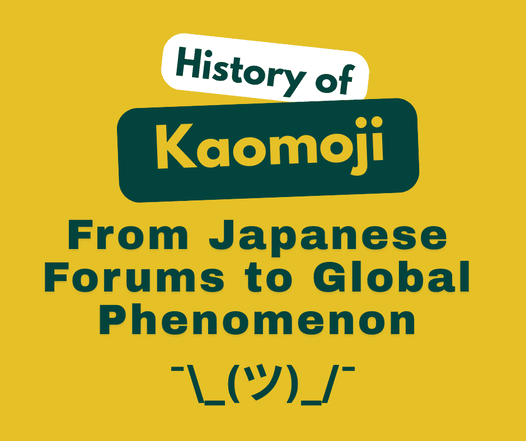
The Explosion: Japanese Forums and 2channel
Kaomoji really took off in the 1990s with the rise of Japanese internet forums. The most influential of these was 2channel (2ch), launched by Hiroyuki Nishimura in 1999.
Because 2channel was an anonymous, text-heavy platform, users needed quick, effective ways to show complex emotions. Since Japanese users could access a much wider range of characters (hiragana, katakana, and kanji), they started building highly detailed and even action-based expressions. Kaomoji were no longer just faces; they showed feelings, actions, and even props. This is how famous, complex examples like the table-flipping kaomoji, (╯°□°)╯︵ ┻━┻, came into being. This creative environment made the kaomoji style famous for its depth and variety.
Global Impact and Lasting Legacy
Kaomoji went global mainly because of the international popularity of anime, manga, and Japanese gaming culture throughout the 2000s. People worldwide loved the "kawaii" (cute) aesthetic and found that kaomoji offered a greater emotional range than simple Western emoticons.
The widespread adoption of Unicode, a system that standardized how characters are displayed across all computers, made it easy for complex kaomoji to be used anywhere.
Even though Emoji (the picture icons invented by Shigetaka Kurita in 1999) have become the international standard for pictorial communication, kaomoji still hold a special place. They remain popular because they are dynamic, flexible, and feel more personal than a standard picture icon. They prove that a creative string of text can be just as powerful as an image in expressing human emotion.